Showing posts with label Unit 11 - Film Studies. Show all posts
Showing posts with label Unit 11 - Film Studies. Show all posts
Monday, 9 May 2016
Applying Lacan to Film
Lacan's theory of lack can be applied to this particular scene in whiplash, we see the protagonist wants to achieve his goal so much that he becomes obsessed and takes up repetitive practice in order to achieve his goal of being a perfect drummer. We see this when close ups of the drummers face and hands whilst playing the drums, quite literally producing blood sweat and tears. Also in this scene we see the camera tracking along the drums, this helps to promote the high speed intensity of the drumming and the speed in which he is playing at, by doing this it helps to show his determination and how much he wants to succeed. We also see how much the protagonist wants to succeed and meet the demands of his mentor when we see him smashing symbols and throwing equipment about. As the tension in the scene builds this is shown via the use of diegetic sound, the tension continues building until the diegetic sound stops, this helps for us to go inside the mind of the rummer and feel the intensity of the drumming.

Monday, 4 April 2016
Laura Mulvey (Male Gaze) - Vertigo
In the film 'Vertigo' by Hitchcock the male gaze can be easily applied as the narrative of the text itself is about a male protagonist who is obsessed with a female name Madeline. Due to the film showcasing the obsession the protagonist Ferguson has with Madeline, as an audience we are able to see the gaze itself in action at many points.
An Example of this gaze can be seen in this 'peeping tom' scene, here we take on Ferguson's gaze as he watches and stares at Madeline. We see that he is pictured in very low key lighting which indicates that he wants to be hidden as being caught peeping would make him look like a pervert, opposed to Madeline who is situated in very high key lighting walking around look at flowers. The next shot we see is of him peeping through the door, to show exactly what he is doing, before the camera again takes on his gaze. Although the shot in which we see isn't of a woman being sexualised or objectified like it would be usually, what Ferguson is looking at his still fulfilling the same desires.
Friday, 11 March 2016
Sigmund Freud - Enemy

When first watching this film it posed many many unanswered questions e.g. Why are there spiders involved? and many involving the 'twins'.
After watching the film more than once it is clear to see that there isn't actually wins involved in the film at all and that it is just the protagonist named Adam Bell, projecting to parts of his psyche. By applying Sigmund Freud's theory of psychoanalysis it is easy to defer that the 2 characters that to a passive audience can be seen as twins are actually representative of the Superego and the id.
The protagonist which we are first introduce to Adam Bell, the central protagonist within the film, is subject to leading a very boring and repetitive lifestyle, he works as a history lecturer, everyday he goes to his lectures and then goes home, his appearance is rather boring and as a character he doesn't seem anything new or exciting. However the other 'protagonist' we meet named 'Anthony St Claire' appears to be a better dressed, more confident and unable to control his desires as he his known to have engaged in an affair. Anthony St Claire is Adam Bells id and is just a representation of the other side of Adam Bells psyche.

Adam Bell is a representation of the superego and spends the course of the film battling and trying to regulate the id. According to Freud's theory the superego lives by the rules placed into society and this exactly what Adam Bell does, he's got job, he doesn't misbehave and is an all round respectable character.

One of the most important scenes in the film is the scene where the pair are together and are in a car crash, it could be said the that this is the scene in which the superego finally kills and does away with the id part of his psyche. It is clear that this film is trying get inside the protagonists head and project an image of his psyche as he constantly fights with either side of his personalities.
Applying Sigmund Freud's theory to film evaluation
Throughout the course of this study, I applied Sigmund Freud's theory of psychoanalysis to three different films, Fight club (1999), Black Swan (2010) and Birdman (2014). I had to research the theory itself and how to apply it to films, I did this by looking through books and various internet sources. One of my strengths throughout this study was having the ability to apply theory and analyse individual scenes. I was frequently able to watch a scene and then look at mise en scene and characters along with the narrative and detect how the id, ego and superego are represented.
One of my weaknesses however I felt was my research. I did not take the time to carefully research the topic before I began my essay, instead I tried to conduct research alongside writing the essay. Because of this I struggled to continuously keep on writing my essay as I kept having to leave it to continue my research, this may have effected the consistency of my essay. It also meant that I did not always have enough sources to back up points I was making.
One thing that I do need to improve on is the way I talk about how technical codes are used to help show freud's theory within the films. For example talk about how camera angles and lighting are used to show the id, ego and superego and anchor the narrative of the text itself.
Overall I feel that I have written quite good essay which explains various points and theory well. My biggest strength whilst writing this essay was my ability to analyse the films, however I recognise that my weaknesses were my research and ability to talk about how technical codes represent the theory i the film. By correcting my weaknesses it shall help me to improve whilst writing future essays.
One of my weaknesses however I felt was my research. I did not take the time to carefully research the topic before I began my essay, instead I tried to conduct research alongside writing the essay. Because of this I struggled to continuously keep on writing my essay as I kept having to leave it to continue my research, this may have effected the consistency of my essay. It also meant that I did not always have enough sources to back up points I was making.
One thing that I do need to improve on is the way I talk about how technical codes are used to help show freud's theory within the films. For example talk about how camera angles and lighting are used to show the id, ego and superego and anchor the narrative of the text itself.
Overall I feel that I have written quite good essay which explains various points and theory well. My biggest strength whilst writing this essay was my ability to analyse the films, however I recognise that my weaknesses were my research and ability to talk about how technical codes represent the theory i the film. By correcting my weaknesses it shall help me to improve whilst writing future essays.
Tuesday, 8 March 2016
Sigmund Freud - Applying his theory of Psychoanalysis to film
Sigmund Freud was a psychologist who was born on the 6th May 1856 and died on the 23rd September 1939. Freud was the founding father of the Psychoanalysis theory, it was used as a method of treating mental illness as well as being a theory that explains human behaviour. (1) This theory includes 'the id'which is part of the personality formed by desires, 'the ego' which operates alongside the reality principle, it works out realistic way's of satisfying the id's demands and finally 'the superego' which is the regulator of pleasure, it will censor the id, but will also license it.
Throughout the course of this study I will be applying this theory to 3 individual texts, David Fincher's 1999 'Fight Club’ (2), 'Birdman', which was released in 2014 and directed by Alejandro Gonzalez Inarritu (3), and finally 'Black Swan', released in 2010 and directed by Darren Aronofsky (4).
Not only has Freud’s theory of Psychoanalysis been used to analyse films but it has also been a strong influence in the creation of films. In the early days of Hollywood psychoanalysts were mostly seen “evil quacks or hopeless fools” However after the second world war, psychoanalytical ideas gained more currency in America and therefore took on a new role, becoming as Hitchcock said ‘dream detectives’ (5).
‘Fight Club’ directed by David Fincher and was released in 1999, the film focuses on a protagonist played by Edward Norton who is a depressed insomniac. He meets a strange soap salesman called Tyler Durden played by Brad Pitt and they set up an underground fight club together. However as the film progresses it becomes clear that Brad Pitts character Tyler Cruden isn't actually real, he is just the id the protagonist has created to help get way from his boring depressing life.
David Finchers ‘Fight Club’ is a perfect example of a film where Sigmund Freud’s Psychoanalysis can be applied as the film is heavily dictated by the theory itself. The id is formed from the desires of the individual and can be seen in the behaviours of Tyler Durden within ‘Fight Club’ “who steals, screws and hurts what he wants” (6). It doesn't matter what what scenario Tyler is in, if he has a desire he acts upon it, even if this causes pain or inconvenience to others (7).
A key example of this is shown within the scene around the 1 hour and 17 minute mark, where fight club changes into ‘project mayhem’ where members of Tyler’s fight club begin wrecking havoc across the city, this scene shows that Tyler Durden does exactly what he wants when he has the desire to do so. Tyler and the unnamed protagonist smash up cars with baseball bats and then hold a shop assistant at gun point.
Freud's theory is shown via the low key lighting and the mise en scene in the scene where the rules of fight club are introduced. The sequence takes place in a dark basement underneath a club, as it is in a basement it s representative of being deep inside the human psyche. The low key lighting is also a key part of the scene as just like the miss en scene the lighting symbolises the place where they are fighting being deep down within the human psyche.
Freud's theory is shown via the low key lighting and the mise en scene in the scene where the rules of fight club are introduced. The sequence takes place in a dark basement underneath a club, as it is in a basement it s representative of being deep inside the human psyche. The low key lighting is also a key part of the scene as just like the miss en scene the lighting symbolises the place where they are fighting being deep down within the human psyche.
“When he has a desire he acts upon it, even if this causes pain or inconvenience to others”(8). In this scene the fact that Tyler Durden is an id is upheld, he smashes cars without even acknowledging the fact that they are other peoples possessions, he drags the shop owner out of his shop and holds him at gun point, not acknowledging how scared the shop owner is and finally takes no notice when Edward Norton’s character questions Tyler’s actions. This particular sequence therefore clearly shows that Tyler is representative of an id, acting upon desires despite these desires causing other pain.
Tyler Durden is represented within the text as the ID, in contrast to the narrator who represents the Ego. “The ego develops in order to mediate between the unrealistic id and the external real world. It is the decision making component of personality. Ideally the ego works by reason, whereas the id is chaotic and totally unreasonable. (9). In comparison to that of Tyler Durden, the narrator tends to follow all rules of society at the beginning of the film. Freud’s theory also includes ‘the superego’ which develops in order to mediate between the unrealistic id and the ego. It is the decision making component of personality. Ideally the ego works by reason, whereas the id is chaotic and totally unreasonable (10). So the ego works to help mediate the id and superego.
In Fight Club the superego can be found in the support groups that the protagonist attends at the beginning of the film and the fight clubs which allow acts of aggression (11). We find out through the narrative that he goes to these support groups to help solve his problem of insomnia. The support groups also however help the protagonist to feel normal, as only when he is surrounded by death does he start to feel alive. This is subsequently ruined by Marla Singer (who is not ill) who enters the narrative attending support groups as well, due to her being there the protagonist is unable to cry and feel anything meaning the support groups no longer work for him.
Due to the protagonist no longer attending the support groups there is no superego to help mediate the ego and the ID. Because of this the ID begins to take over the protagonists mind and therefore forces him to creates Tyler Durden who he first meets on a ‘flight’.
I believe that the reason the ID takes over the protagonists Psyche is due to the lack of superego throughout the film to help control the id. The id or as he is more formally known within fight club Tyler Durden becomes stronger and stronger after ‘Fight Club’ is born. It goes from a small club where men come to fight each other, to a group of individuals spreading terror across the city in the form of ‘Project Mayhem’. Project Mayhem is what really signifies the id taking over as Tyler has his own gang which he has trained to spread terror across the city. At this point in the film Tyler Durden disappears, leaving the protagonist to look for him. However it is evident that Tyler has disappeared as the id portrayed by Tyler has completely taken over the protagonist that the ego no longer exists and the protagonist intact has became Tyler Durden.
The next text which I will apply Sigmund Freuds theory of psychoanalysis to is Alejandro Gonzalez Inarritu’s 2014 film ‘Birdman’. The film focuses on a fading actor best known for his portrayal of a popular superhero, he attempts to make a comeback in acting by appearing in a Broadway play. As opening night approaches, his attempts to become more altruistic, rebuild his career, and reconnect with friends and family prove more difficult than expected (12).
Sigmund Freud’s Psychoanalytical theory can be applied well to Birdman as the narrative helps to show different sides of the human Psyche. We see sProtagonist Regan Thompson constantly battling with his id which is shown in the form of the superhero he used to play ‘Birdman’. In the scene around the hour mark we see began battling with his ID which is represented as the diegetic sound of a deep voice talking to Regan himself. Regan is in his dressing room arguing with his id, the id shows the greedy but successful side of Regans personality as when Regan says “I was fucking miserable” his id replies “yeah but fake miserable, Hollywood miserable” followed by “Fuck you, you coward, we grossed billions, are you ashamed of that? Billions!”. Regan replies to his id saying “yeah for filing shit everyday, does that make it good?” (13).
In this scene it becomes clear that Regan is trying to overpower his id by trying to make a career as an actor that actually produces respectable work rather than just use something he made years ago just to make money. The scene upholds the battle he is having within his mind of whether he should stick at acting within the theatre and become a respected broadway actor, or just take the easy option of going back to ‘Birdman’ where he makes billions “by making shit everyday” but becomes relevant and rich again.
Later on in the film we see Regan wake up on the side of a street after drinking heavily the night before. He is awoken by the voice of his own id ‘birdman’ telling him to get up. In this seen the use of diegetic sound is used to show how Regans id is trying to take over. The diegetic sound in question is the voice of the id being made to seem as if its coming from the back of Regans mind. We hear the id saying things such as “you’re a movie star man, you’re a global force” and “fuck it we’ll make a comeback, they’re ready for something huge”.
Throughout this sequence we get to see the full extent of Regan’s psychological state, he seems somewhat depressed and down about the way his acting career is going. We are able to see the physical appearance of the id for the first time via the use of a mid shot featuring both the id and Regan. This is done in order to show that the id is getting more and more powerful, not only is the id a piece of diegetic sound in the back of Regans head, it is now visible and walking behind Regan. The power of the id is then confirmed as Regan dissapears totally from the shot and we can only see the id, clicks his fingers and action begins to take place, explosions, helicopters and a big monster appears.
My next and final text in which I will apply Sigmund Freud’s theory of psychoanalysis to is Darren Aronofsky’s Black Swan, released in 2010. The film revolves around a ballerina called Nina who's life is compleltey consumed with dance. She lives with a controlling mother and lands the lead role in her dance company’s production of Swan Lake, however Nina can only perfect the white swan dance, not the black swan, another ballerina lily can perfect the black swan. Nina becomes more in touch with the black swan as the film goes on and ends up killing herself. (14)
Within this text Sigmund Freud’s theory can be applied, one way of doing this is talking about the id that is frequently referred to throughout the film as the black swan. At first we see the black swan as something Nina strives to become, however due to her obsession with being perfect she genuinely faces a battle of her id taking over, and eventually she becomes the black swan.
In the final scene of the film we see Nina fully transform into the black swan, and her id is shown by the camera showing a close up of her possessed looking deep red eyes. She dances around the stage and the powerful ferociousness of her id taking over is shown by the diegetic sound of the the swan lake music getting increasingly faster and louder and via the quick cuts between shots. The film ends with Leah lying motionless on a bed after a suicide stunt at the end of the film, her eyes now no longer red, the camera zooms slowly into her blank face, indicating the id is no longer present.
There are certain points within the film where we see that Leah’s id is present, the first being when she discovers the rash on her back. Later on we see a close up showing what appear to be black feathers growing out of it, only she sees this however and her mother says it was Nina scratching herself due to pressure of the show. The rash is frequent throughout the film, however the id is first seen when Leah flips out at her mother and we see a close up of her red eyes the first time.
The superego part of Freud’s psychoanalysis theory is shown, the superego incorporates the values and morals of society which are learned from ones parents and others, and its function is to control the id’s impulses. In black swan the superego can be seen in the form of Nina, who is pure, childlike and lives under the rules and the reign of her mother. We see her childlike actions in a sequence that take place at her dance instructors flat, where he asks her if she masturbates, she responds very immaturely and doesn't give an answer as her mother has tried to shield her away from sex and boys.
Wednesday, 9 December 2015
Tuesday, 8 December 2015
Freud - Structure of The Personality
Sigmund Freud's model of the human personality was considered pioneering, he suggested that the human psyche was made up of 3 interacting elements:
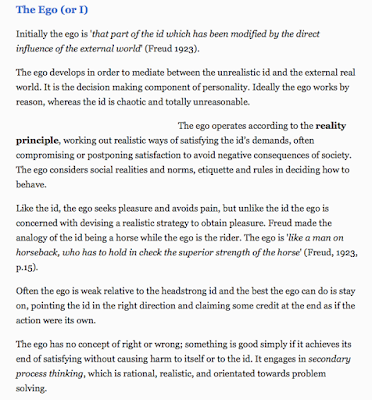
The Ego- The ego operates alongside the reality principle, it works out realistic ways of satisfying the id’s demands, often by postponing pleasure to avoid negative consequences of society. Like the id the ego avoids pain and seeks pleasure, however unlike that of the id, the ego remains realistic in its search for pleasure. Freud made the analogy that the id is like the horse and the ego is the rider, "The ego is like a man on horseback, who has to hold in check the superior strength of the horse" (Freud, 1923, P15). The ego engages in secondary process thinking, which is realistic, rational and is orientated towards problem solving.
The Superego- This is the regulator of pleasure, it will censor the id, but will also license it. For example in the film 'Fight Club' the superego appears in a number of different forms, initially in the self help groups which allow him some sleep and then within the fight clubs which allow the acts of aggression. The superego may also be identified with the police who enter the narrative at moments of crisis. The superego is developed when one realises the social norms of society.
 The id- This part of the human personality is formed via the desires of an individual and can be seen in the film 'Fight Club' through the character of Tyler Durden who effectively does what he wants whether thats hurting people, sleeping with whoever he wants or stealing whatever he wants. Whenever he has a desire he acts upon it, even if this causes pain or inconvenience to others. The id demands instant satisfaction and when this happens we experience pleasure, when it is denied we experience displeasure or pain. Freud believed that the id operated on the 'pleasure principle' which is the idea that every wishful impulse should be satisifed immediately regardless of the consequences.


References - http://www.simplypsychology.org/psyche.html
The Pocket Essential 'Film Studies' - Andrew M.Butler
The Ego- The ego operates alongside the reality principle, it works out realistic ways of satisfying the id’s demands, often by postponing pleasure to avoid negative consequences of society. Like the id the ego avoids pain and seeks pleasure, however unlike that of the id, the ego remains realistic in its search for pleasure. Freud made the analogy that the id is like the horse and the ego is the rider, "The ego is like a man on horseback, who has to hold in check the superior strength of the horse" (Freud, 1923, P15). The ego engages in secondary process thinking, which is realistic, rational and is orientated towards problem solving.
The Superego- This is the regulator of pleasure, it will censor the id, but will also license it. For example in the film 'Fight Club' the superego appears in a number of different forms, initially in the self help groups which allow him some sleep and then within the fight clubs which allow the acts of aggression. The superego may also be identified with the police who enter the narrative at moments of crisis. The superego is developed when one realises the social norms of society.
 The id- This part of the human personality is formed via the desires of an individual and can be seen in the film 'Fight Club' through the character of Tyler Durden who effectively does what he wants whether thats hurting people, sleeping with whoever he wants or stealing whatever he wants. Whenever he has a desire he acts upon it, even if this causes pain or inconvenience to others. The id demands instant satisfaction and when this happens we experience pleasure, when it is denied we experience displeasure or pain. Freud believed that the id operated on the 'pleasure principle' which is the idea that every wishful impulse should be satisifed immediately regardless of the consequences.

References - http://www.simplypsychology.org/psyche.html
The Pocket Essential 'Film Studies' - Andrew M.Butler
Lacan - The Mirror Stage
Lacan's theory of 'the mirror stage' refers to the idea that when baby's look into the mirror they believe that what they see is superior in comparison to themselves. They fail to understand that the reflection they see is them and instead set the reflection as an icon to worship and will strive to correspond to the image in which they see.


In the same way women often take on the same behaviour in cinema; the ideal depiction that they see on screen is a representation of a superior being that they see and straight away wish to transform themselves into. By seeing the ideal image on screen it therefore can result in the female audience believing that they are nothing more than an object to be watched and admired. Because of this people can develop body dysmorphia.

Subscribe to:
Posts (Atom)